Relational reality

Working notes, made public

Relational reality

Space, time, dimension, the speed of light, matter and gravity are not put in at the start. They are what a world of persistent places looks like when each place carries a clock, and the only interactions are coincidences of ticks.

The picture

There are places, and there are events. A place is not created or destroyed. It carries its own clock, which ticks at a local rate, the lapse. Each tick is an event. A link between two places is not a rod laid down in advance: a link fires when both ends are active together, so its rate goes as the product of the two lapses.

01 · Light

First arrival

A signal spreads along links. Light is the front of first arrivals. On a statistically isotropic substrate that front is round, and it defines a cone and a common speed.

02 · Matter

Clocks that move

Matter rides the same links and reads the same ticks. Its size and its internal clock are both set by the local rate, so the speed it measures for light stays constant.

03 · Gravity

News of extra ticks

Matter places tick a little faster. That news propagates, and the clocks that receive it slow down. Gravitational time dilation is the slowing. The hard part is which news to send.

Schematic of places, a coincidence, and a first-arrival front Five places in a row. Each is a circle with a clock hand. The middle link is marked as a coincidence, with both neighbouring clocks firing. A dashed arc to the right is the first-arrival front. coincidence first arrival
A schematic, not a simulation. Places persist. A link is a coincidence of ticks. Light is the first-arrival front of those links.

Because link rates scale as the square of the lapse while clocks tick at the lapse itself, rulers shrink near mass and the local speed of light stays one. The metric read by matter is then ds² = −λ² dt² + λ⁻² δij dxⁱ dxʲ. With λ = e^Φ the weak field has the PPN parameters β = γ = 1.

Where the programme stands

Every line below is a status from the research log after round 25, including the corrections from an independent reading of the drafts. Nothing here is offered as settled physics.

Holding in the simulations

  • Light as a first-arrival front, with an emergent cone.
  • Special-relativistic kinematics for zigzag matter on the substrate.
  • γ = 1 from the coincidence rule. On a two-dimensional Delaunay graph the ratio of arrival delays was 1.95–2.01, against a predicted factor 2. Deflection ratios were noisier, 1.66–2.24.
  • Universal free fall of phases in 3+1.
  • A tick-jitter decoherence law.
  • Local clock synchronisation that keeps a size-independent phase order in three dimensions and loses it in one and two.

Already excluded

  • Scalar-only gravity. It has no frame dragging, while Gravity Probe B measured a Lense–Thirring precession of −37.2 ± 7.2 mas/yr. Its preferred-frame parameters sit far outside existing bounds. It radiates a breathing mode, which polarisation tests disfavour.
  • The claim that gravity “must be a U(1) connection”. With exact rates that connection is pure gauge: a change of variables, not a new field.

Still open

  • A tensor news rule whose monopole weight is the conserved energy, m(1 + v²/2 + Φ/2), together with the field terms needed so that energy and momentum are actually conserved.
  • Whether that sector still ends at the exponential metric. A shadow 4.63% larger than Schwarzschild, and the absence of Hawking evaporation, are conditional on it. They are not claimed yet.
  • Three dimensions. Four known criteria meet in this substrate, and a static counting condition closes only for D = 3, but that is a consistency condition under strong assumptions, not a proof that three dimensions had to happen.

Examples from the runs

The figures are the ones in the drafts. Values are transcribed from the research log or from re-runs of the scripts in this repository. They illustrate the model. They are not new theorems.

Phase order needs three dimensions

Clocks coupled only when neighbours coincide behave like a noisy XY model. Long-range phase order is absent in one and two dimensions at noise of order one, and it holds in three. That is the pattern the Mermin–Wagner theorem leads one to expect. The same split appears on lattices and on random graphs of matched degree.
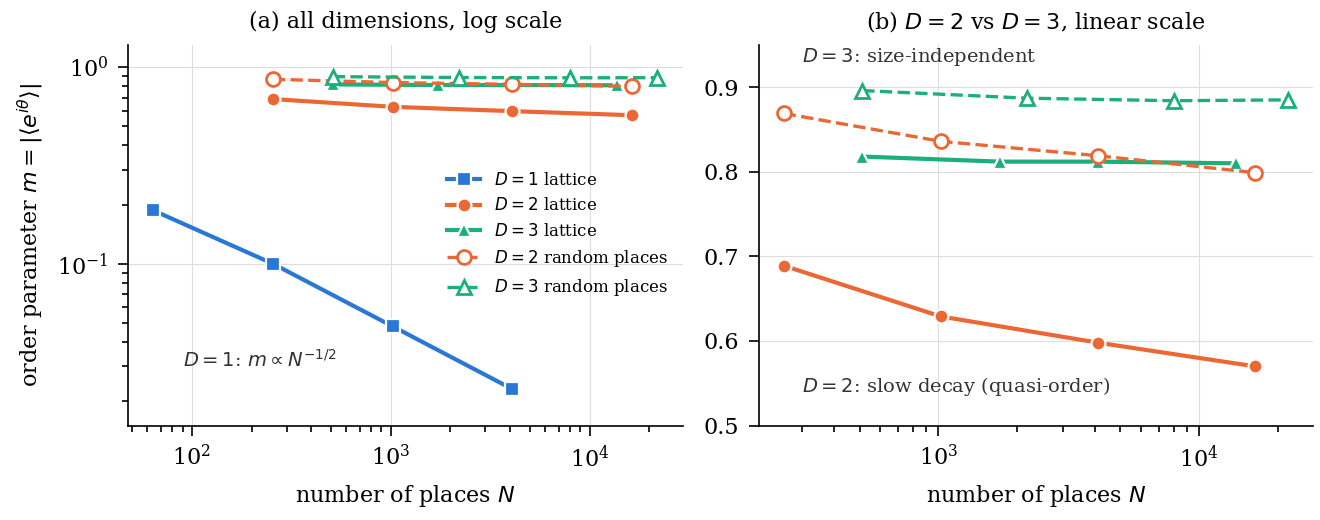
Two panels of order parameter versus number of places. In one dimension the order falls toward zero. In two dimensions it decays slowly. In three dimensions it stays near 0.81 on lattices and near 0.89 on random graphs.
Order parameter m = |⟨e^{iθ}⟩| against the number of places. Panel (a) is logarithmic. Panel (b) compares D = 2, which keeps drifting down, with D = 3, which does not. From the draft on three spatial dimensions.
0.187 → 0.023 One-dimensional lattice, from 64 places to 4,096. The order falls like 1/√N.
0.689 → 0.570 Two-dimensional lattice, L = 16 to 128. A slow decay, not a plateau.
0.818 → 0.810 Three-dimensional lattice, L = 8 to 24. Size-independent within the run.

A few percent of random long links restores a plateau even in two dimensions. Macroscopic coherence also cannot be built by local synchronisation within the age of the universe, so if the picture is right, that coherence has to be inherited.

Synchronising clocks in a gravitational gradient

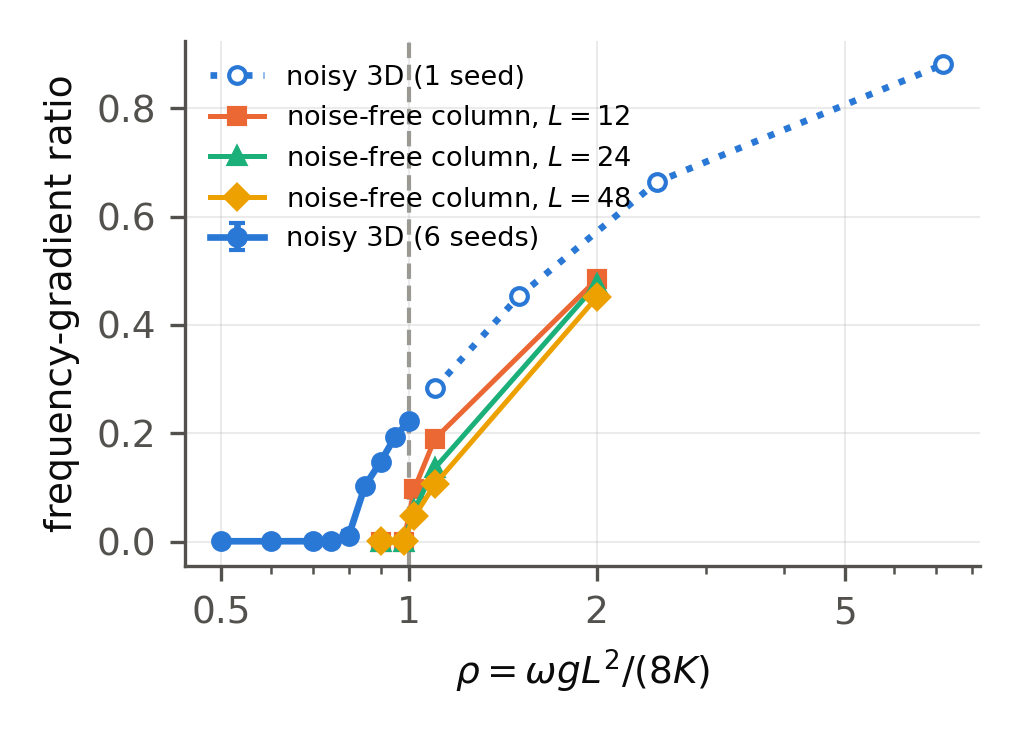
Identical noisy clocks sit on a lattice in a lapse λ = 1 + gz. If neighbours pull each other’s phases together and do nothing about rates, they either lock to one common rate, which erases a real redshift, or the column breaks into slipping clusters. The crossover for an open column is the known chain condition of Strogatz–Mirollo and Ermentrout–Kopell, read as a locking length ℓ_lock = √(8K / ωg). The parameter is ρ = ω g L² / (8K).
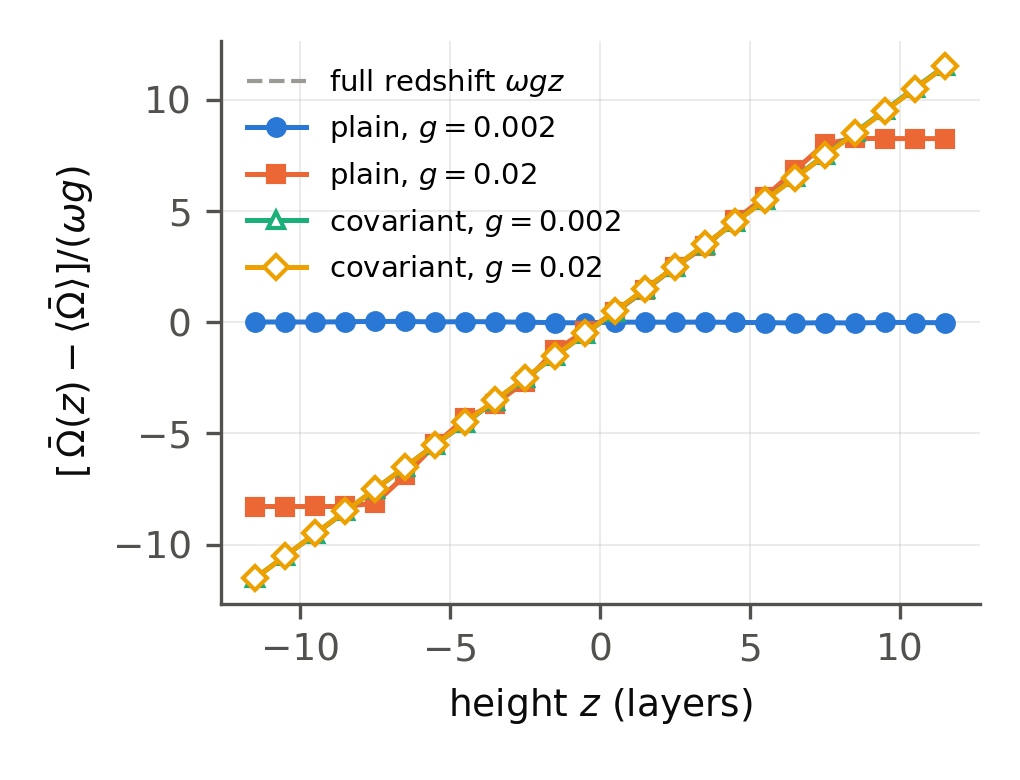
Layer frequency, scaled by omega g, against height. The full redshift is a dashed line of slope one. Plain coupling at g = 0.002 is flat. Plain coupling at g = 0.02 rises with a shallower slope. Covariant coupling at both gradients follows the dashed line.
Mean rate against height, in units of the imposed gradient. Flat means the redshift has been erased. The dashed line is the full redshift. Covariant coupling tracks it. With exact rates that tracking is a change of variables. The new question is what happens when each link has to measure the rate offset.
Frequency-gradient ratio against rho on a logarithmic axis. A vertical dashed line marks rho = 1. Noise-free columns of three lengths stay near zero below rho = 1 and rise above it. The noisy three-dimensional scan stays near zero until about rho = 0.8 and then climbs.
Frequency-gradient ratio against ρ. Noise-free columns of height 12, 24 and 48 lock below ρ = 1 and slip above it. In the noisy three-dimensional model the effective threshold on this grid is ρ_eff = 0.842 ± 0.008, and it moves lower if the run is longer. That shift is noise-activated slipping.
0.002 ± 0.002 Frequency-gradient ratio at ρ = 0.72. Below the locking length the redshift is gone.
0.884 The same ratio at ρ = 7.2. The column has split into slipping clusters.
~1 radian Coherence fails once the accumulated error in a measured rate connection reaches about one radian.

Bond stability in flat space is 0.849. Under plain coupling at the steep gradient it falls to 0.420 ± 0.004. With a noisy estimate of the connection, the mean redshift survives and the phase order does not. That calibration tolerance is the result in the second draft that is actually new.

Drafts

Both were revised after an independent reading. Before any submission the references that were added from memory still have to be checked. Further papers, including one on the strong-field metric, wait on the open gravity calculation.

The PDF files are in English.

Draft · 9 pages

Three spatial dimensions in a relational clock substrate

Known criteria for the dimension of space — stable orbits, transient random walks, and long-range phase order — written in one substrate, plus a static counting condition that is consistent, for non-trivial gravity, only in three dimensions. The exterior field is then the exponential metric. The paper says plainly what is classical, what is a known theorem under a new premise, and what the gravity sector has already ruled out.

Draft · 7 pages

Synchronising noisy clocks in a gravitational field

Neighbour coupling of identical noisy clocks either erases a gravitational redshift or slips. The locking length is a known oscillator-chain condition applied to a linear lapse. An exact rate connection restores the redshift only by a change of variables. When the connection is measured, with noise, phase coherence has a finite lifetime.